
Walking through Fez el-Bali for the first time can be a little confusing. The streets are narrow, the turns come quickly, and a busy market street can suddenly become a quiet passage with only a few doors and shops.
What helped me enjoy it more was stopping to look at what was actually happening around me instead of trying to reach the next famous place as quickly as possible. A workshop opening onto the street, someone carrying bread home, a small fruit stall, or the sound of metal being worked could be just as interesting as the main sights.

Understanding the Layout of Fez el-Bali
Fez el-Bali is not laid out like a modern shopping district. There are wider routes that carry most of the movement, then smaller lanes branching away from them. Some are packed with shops, while others mainly lead toward homes, workshops, mosques, or small local businesses.
The first few times through the medina, I had to pay more attention to landmarks than street names. A particular doorway, a fountain, a busy shop, or even the shape of an alley could become a useful reference when returning through the same area.
That made the medina feel less confusing after a while. I stopped worrying about taking exactly the right turn and started remembering the places that helped me know roughly where I was.
The Main Arteries: Tala'a Kebira and Tala'a Seghira
Tala'a Kebira and Tala'a Seghira are two of the better-known routes through Fez el-Bali. They pass through busy parts of the old medina and connect with many smaller streets.
They are useful when you need to get your bearings because the smaller lanes can change quite quickly. Shops, food stalls, workshops, and entrances to other streets appear one after another.
After a while, I started using these two streets as reference points whenever I got turned around. If I had gone too far into the smaller alleys, finding one of them again usually gave me a clearer idea of where I was.
The Master Artisans: Key Craft Souks Explained
One of the things that makes the souks of Fez different from a normal shopping area is the presence of working craftsmen. In some parts of the medina, you can see the work being done instead of only seeing the finished product in a shop window.
Leather, metal, wood, textiles, pottery, and other traditional crafts are associated with different parts of the old city. The atmosphere changes with them too. A street filled with metalwork sounds very different from one where wood is being cut and carved.
For me, those small differences made walking through the souks more interesting. You could often tell what kind of work was happening nearby before seeing the workshop itself.
Chouara Tannery and Leather Souks

Chouara is one of the places where the traditional side of Fez is particularly easy to see. From the terraces above the tannery, the rows of vats form a pattern of different colors, while workers move between them.
The smell is usually the first thing people notice. It is strong and difficult to ignore, especially when you are standing close to the tannery.
After seeing the tannery itself, the leather shops around the area make more sense. Bags, belts, slippers, jackets, and other leather goods are displayed in shops nearby, showing the finished side of a process that begins much earlier.
I found it more interesting to look at the whole area rather than only taking a quick photograph of the colored vats. The shops, workers, narrow passages, and smell all make the place feel very different from an ordinary market.
Place Seffarine (Coppersmith Square)
Place Seffarine has a completely different sound.
The first thing that stands out is the repeated noise of metal being hammered. Around the square and nearby workshops, copper and other metal objects are worked by hand.
Teapots, trays, lamps, and decorative pieces can be seen in the surrounding shops. Some are already polished and ready for sale, while others show more clearly how much work goes into shaping and decorating them.
I would not spend too much time looking only at the finished products here. The workshops themselves are what give the area its character. Watching the work for a few minutes tells you more about the place than another row of finished souvenirs.
Souk el-Attarine (Spice and Perfume Market)

Souk el-Attarine feels different again. The shops here are filled with spices, herbs, oils, and other traditional products, so the smells change as you walk from one shop to another.
Some displays are very colorful, with products arranged in bowls, jars, or sacks. Others are much simpler, with only a few things placed outside the shop.
What I liked about this part of the medina was that it did not feel like one large store. Each small shop had its own display, and some of the products were being sold for ordinary household use rather than simply as souvenirs.
Souk Nejjarine (Woodworkers Market)
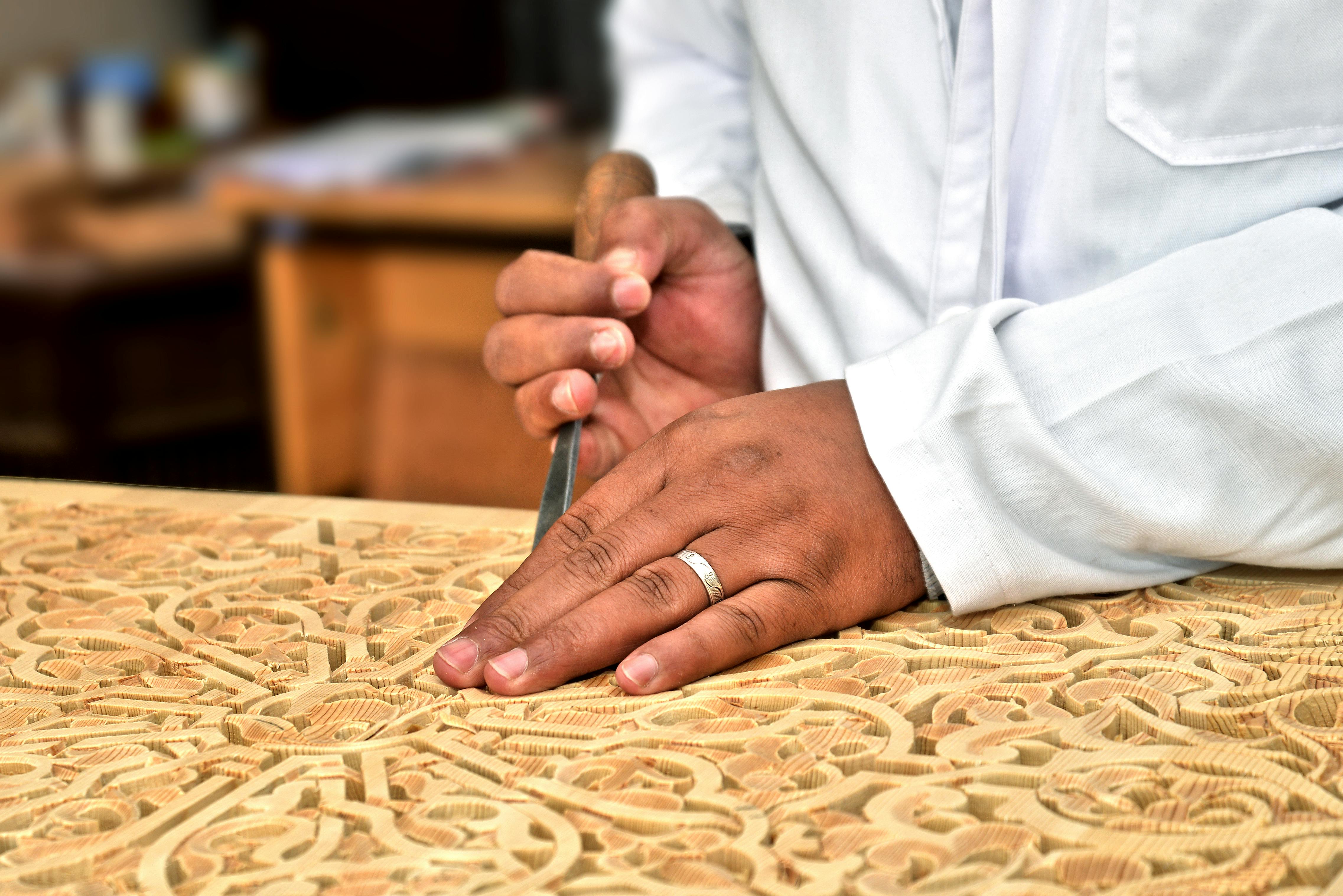
The Nejjarine area gives the medina another change of atmosphere. Here, wood and woodworking become much more noticeable.
The difference is easy to see in the workshops. Instead of finished metal objects or leather goods, you may come across pieces of wood, carving tools, shavings, unfinished objects, and decorated panels.
The Nejjarine Museum of Wooden Arts and Crafts is also located here, inside the historic Fondouk Nejjarine. The building itself is closely connected with the area's woodworking tradition, and the museum focuses on traditional Moroccan woodwork and related objects.
What makes this section more interesting than simply looking at wooden souvenirs is seeing the tools and unfinished work. A carved panel looks very different when you notice the marks, cuts, and small pieces of wood around the workshop where it is being made.
Food Markets and Culinary Souks
After spending time around the craft souks, the food markets bring a completely different rhythm.
There are fruit and vegetable stalls, bakeries, spice shops, butchers, small food counters, and shops selling everyday ingredients. The selection changes depending on the street, but food is never far away.
Some parts of the medina feel more like a neighborhood market than a sightseeing area. People stop briefly to buy something, carry bags home, talk with shopkeepers, and continue on their way.
Fresh Produce and Daily Essentials
Fresh produce is one of the easiest things to notice when walking through the busier market streets. Fruit and vegetables are usually placed where they can be seen immediately from the alley.
What I liked was the mixture of visitors and ordinary shopping. Someone might be taking photographs a few meters away while another person is simply buying vegetables for dinner.
That small contrast says a lot about the medina. It is a historic place visited by travelers, but it is also a place where people still come to do everyday shopping.
Street Food Highlights and Local Specialties
Food smells can change quickly in the souks. One street may smell strongly of spices, then a bakery appears, followed by a stall selling cooked food or grilled items.
There is no need to turn every food stop into a major meal. Sometimes the most memorable part is simply seeing what people are buying and what is being prepared at that particular moment.
Traditional Fassi cuisine is another part of the city's identity, and food remains closely connected to daily life in and around the old medina.
Market Etiquette, Haggling, and Purchasing Real Crafts
Shopping in the souks can be very different from shopping in a regular store. Some prices are fixed, while other products leave room for a conversation about the price.
The easiest way to approach it is to look first and decide whether you genuinely want the item. If you do, ask the price and see where the conversation goes.
There is also a difference between browsing and buying. If I was only looking, I preferred to make that clear rather than spend a long time negotiating over something I did not intend to take home.
How Haggling Works
Haggling can feel strange the first time you do it, especially if you are used to fixed prices.
In the souks, it can be a simple back-and-forth conversation. You hear the first price, make another offer, and decide whether the final amount works for you.
If it does not, walking away is an option. There is no reason to turn a small purchase into an argument.
The important part is knowing what you are willing to pay before the conversation goes too far. That makes it easier to decide when to continue and when to leave.
Distinguishing Mass-Produced from Authentic Handmade Goods
This can be difficult when you are seeing many similar products in different shops.
One useful thing is to look beyond the finished display. Ask where something was made and how it was produced. If you are interested in a particular craft, seeing a workshop can give you a better idea of what handmade production actually looks like.
Small differences in carving, stitching, finishing, or shaping may become more obvious when you compare several pieces side by side.
I would also avoid buying something simply because a seller tells you it is handmade. Take a look at the object itself and decide whether you like the quality and finish.
Everyday Life: Etiquette, Safety, and Logistics
Right of Way in Narrow Alleys

The narrow streets are easy to enjoy when you remember that they are working streets, not just walking routes for visitors.
Donkeys, carts, shop deliveries, and local residents all have to use the same limited space. In some alleys there is barely enough room for two people to pass comfortably.
When drivers or people moving goods call out, it is usually a sign to move toward the side and let them through. The easiest mistake is to keep walking without looking behind you while concentrating on the shops.
I learned to listen for those calls instead of waiting until someone was right behind me. It made walking through the busiest passages much easier.
Taking Photos
The medina offers plenty of interesting scenes, but not everything needs to be photographed.
If someone is working inside a small workshop, asking before taking a close photograph is the better approach. The same applies when photographing people at close range.
For general street scenes, I found it easier to step to the side, wait for a clear moment, and take the photograph without blocking the people using the street.
Getting Lost in the Medina
Getting turned around is normal in Fez el-Bali. The important thing is not to panic and keep walking deeper into unfamiliar alleys.
When I lost my sense of direction, going back toward a wider street or a place I recognized worked better than trying to guess the route from memory.
Keeping a few reference points in mind also helps. A square, a fountain, a familiar shop, or one of the larger streets can be enough to reset your direction.
Respecting Workshops and Local Life
The people working in the medina are not there only for visitors. Their shops and workshops are part of their normal working day.
That is worth remembering when entering a small shop, looking at someone's work, or taking photographs. You can browse without buying, but being clear and polite avoids unnecessary pressure on both sides.
The same applies to residential streets. Not every quiet doorway or narrow passage is a tourist attraction. Sometimes it is simply someone's home.
Final Thoughts
The souks of Fez are easier to appreciate once you stop looking at them as one large market.
Chouara has its leather and tanning work. Seffarine has its metalworkers. Around Nejjarine, wood becomes part of the landscape. Elsewhere, the smells of spices, bread, fruit, and cooked food take over.
What stayed with me most was how quickly the atmosphere could change. A crowded shopping street could lead into a quiet alley, then open again near a busy workshop or food market.
You do not need to see every souk in one walk. Some of the best moments can happen between the places you originally planned to visit: hearing a hammer from a workshop, stopping at a food stall, finding a small shop, or realizing that you have taken a completely different turn from the one you intended.
