
When I first started spending time in Tangier, one thing I noticed very quickly was how often people sit in cafés with a glass of mint tea in front of them. At first, I thought it was simply a normal Moroccan drink. But after spending more time in the city, I understood that it is much more than that.
In Tangier, having mint tea can be part of your whole day. You can sit down after walking around the Medina, meet someone for a short conversation, or simply stay alone and watch people passing by. For me, this slow way of enjoying a drink was one of the things that made Tangier feel different.

Tangier is also a very special city because of its position between Africa and Europe. You can feel this mix in many parts of the city, and I noticed it especially when visiting some of its old cafés. There is a connection between the cafés, the city's history, artists, travelers, and everyday local life.
So in this article, I want to share my experience with Moroccan mint tea in Tangier, the cafés I found interesting, and some practical things that are useful to know before you go.
Moroccan Mint Tea (Atay B'naana)
Before spending more time in Tangier, I already knew Moroccan mint tea, but I did not really think about all the small details that go into preparing it.
The traditional tea is made with Chinese gunpowder green tea, fresh spearmint leaves called naana, and sugar. In Northern Morocco, especially around Tangier and the Rif mountains, you can also find local variations.
Depending on the season, some people add herbs such as wild thyme, pennyroyal (flio), absinthe (sheeba during the winter), or lemon verbena (luisa).
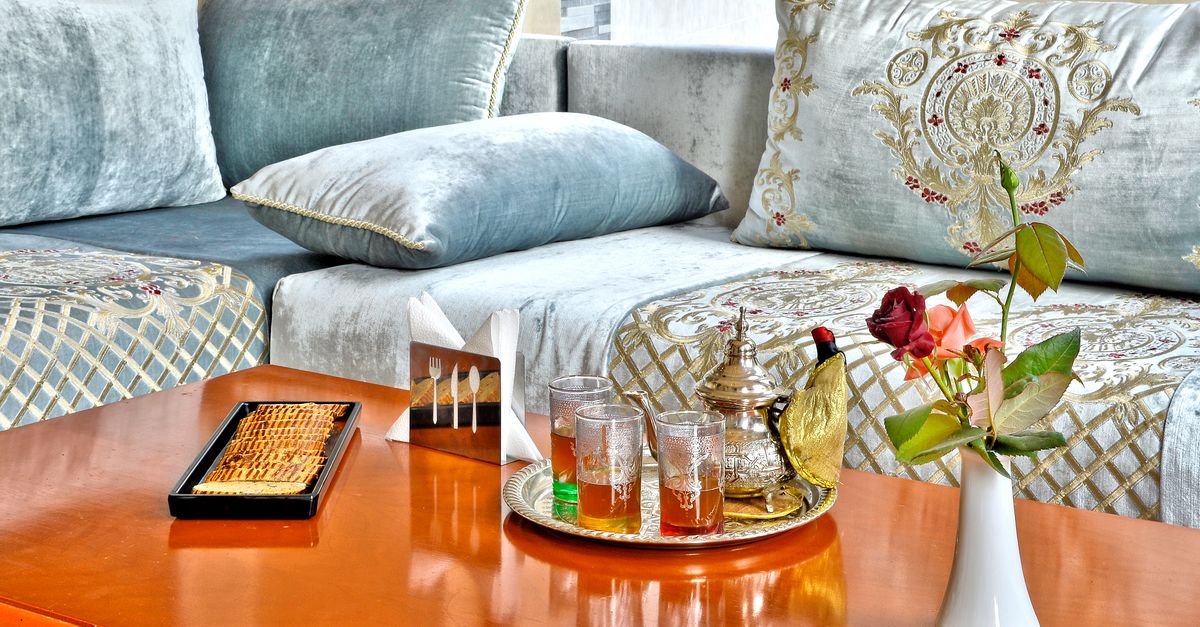
What I liked is that preparing the tea is not treated like a quick process. The tea leaves are rinsed with boiling water before the tea is prepared in a traditional metal teapot called a berrad. Fresh mint and sugar are then added to the pot.
There is also something you will probably notice when the tea is served. The tea is poured from quite a height into the glass. At first, I wondered why they did this, but it helps mix the sugar, cool the tea slightly, and create the small foam on top called reghwa.
The taste is usually strong, sweet, and very refreshing because of the mint. In the north, I found that the flavor can also have a slightly different herbal taste depending on what is added.
One small warning: the tea can be extremely hot. The traditional glasses do not have handles, so I found it more comfortable to hold the glass near the top and bottom rather than around the middle.
Cafés and Everyday Life in Tangier
One thing that helped me understand Tangier better was spending time in its cafés.
Tangier has a very interesting international history. Between 1923 and 1956, the city was an International Zone administered by several Western powers and Morocco. This period attracted writers, artists, diplomats, travelers, and many other people from different countries.
Names such as Paul Bowles, William S. Burroughs, Henri Matisse, and Jack Kerouac are connected with Tangier's international and artistic history.
Today, the old International Zone is part of history, but the café culture is still very much alive. People use cafés to meet friends, talk about everyday life, discuss business, watch what is happening around them, or simply sit quietly with a drink.

Café Hafa: Tea With a View
Honestly, Café Hafa is one of the places that I would remember from a visit to Tangier.
The café is located on the cliffs of Marchan, overlooking the Strait of Gibraltar. What makes it different is the way the seating goes down the hillside toward the water.
On a clear day, you can look across the water toward Spain. I think this is one of those places where the view is just as important as the drink you order.
Why I Liked Café Hafa
The café does not feel overly modern or luxurious. The simple blue and white benches, the cushions, and the open terraces give it a relaxed feeling.
It also has a long history. Over the years, famous visitors have included the Rolling Stones, William S. Burroughs, and members of the Beatles. But what I found more interesting is that the café is still used by ordinary people: students, families, artists, and travelers.
When to Visit
For me, late afternoon is a good time to visit, especially around an hour before sunset. The light over the Strait can make the whole place look different.
I would simply order Moroccan mint tea and take my time. You can also find simple snacks such as sunflower seeds and local pastries nearby.
Café Hafa is in the Marchan neighborhood. From the Medina, it is roughly a 20-minute uphill walk, although taking a petit taxi is much easier if you do not want to walk uphill.
One thing to remember is that seating is first-come, first-served. On sunny weekends, the terraces can become busy, so going earlier can save you from waiting for a good place.
Café de Paris and Place de France
After Café Hafa, Café de Paris gives you a completely different feeling.
It is located at Place de France in the Ville Nouvelle. Instead of sitting on a cliff and looking at the sea, here you are sitting in the middle of the city and watching people, cars, and everyday Tangier life.
The café dates back to the French protectorate period and has a more traditional boulevard-café atmosphere, with its terrace and classic interior details.
Watching the City
This was one of the things I enjoyed about this type of café. You do not really need to do anything.
You can order a tea, sit outside, and simply watch the city move around you.
The café also has an interesting history connected with diplomats and international visitors. The service has kept some of that old-fashioned feeling, with waiters wearing traditional formal uniforms.

Café Central and Petit Socco
If you want to experience the older side of Tangier, I would spend some time around Petit Socco.
The square is located deep inside the old Medina and has historically been one of the important meeting points in the area.
When I walked around this part of the Medina, I could understand why cafés became such an important part of Tangier's history. The streets are busy, the buildings are old, and there is always something happening around you.
The Atmosphere of Petit Socco
In the middle of the 20th century, Petit Socco became closely associated with the bohemian side of Tangier. Writers could sit for hours in cafés, write, observe people, and simply enjoy the atmosphere.
Today, the square is pedestrianized, which makes it easier to sit outside and watch the activity around you.
Café Central: This is a good place to sit directly on the square while taking a break from walking through the Medina.
Café Fuentes: Located nearby, it offers traditional hot drinks and views of the surrounding historic architecture.
If you want to relax properly, I would give yourself around 45 to 60 minutes here. There is no need to drink your tea quickly and leave.

Cinéma Rif and Café Cinema
For something a little more modern, I would also visit Place 9 d'Avril, which many people know as Grand Socco.
At the edge of the square you will find Cinéma Rif, an Art Deco cinema that is home to the Tanger Film Library, also known as Cinémathèque de Tanger.
The café inside the cinema has a different atmosphere from the traditional cafés in the Medina. You can find local filmmakers, students, photographers, and young people interested in culture.
I liked the fact that you can still order Moroccan mint tea here, but you can also find espresso, fresh juices, and light baked goods.
It is a nice example of how Tangier's café culture continues to change while keeping some of its traditional side.
How to Order Mint Tea in Tangier
Ordering tea is actually very simple.
In Moroccan Arabic, you can simply ask for atay. In French, which is also widely used in Tangier, you can say thé à la menthe.
If you do not want too much sugar, you can ask for the sugar separately. In Darija, you can say sukkar b'roho, or in French, sucre à côté.
However, in traditional cafés, the tea is often already sweetened in the pot. So it is better to mention your preference when ordering.
Women, Families and Café Culture
There is something worth knowing about cafés in Morocco. Traditionally, some small neighborhood teahouses were mostly male spaces.
But in Tangier today, many of the better-known places are welcoming to everyone. Café Hafa, Café de Paris, Cinéma Rif, and the cafés around Petit Socco can be visited by women, solo travelers, families, and tourists.
Some very local cafés in quieter neighborhoods can still have a mostly male clientele. If you are looking for a more comfortable first experience, I would choose a larger café, a boulevard terrace, a hotel terrace, or one of the cultural cafés.
Paying for Tea and Tipping
One practical thing I would keep in mind is cash.
Small cafés do not always accept cards, so I recommend keeping some Moroccan dirhams with you, especially small notes and coins such as 10, 20, or 50 DH.
The original guide gives an approximate price of 10 to 20 MAD for a glass or small pot of mint tea at a standard local café. More expensive hotels or special terraces may charge around 25 to 40 MAD.
For tipping, leaving a small amount of change is common. Around 1 to 5 MAD per person can be left for the server.
Do Not Rush Your Tea
This is probably the most important thing I would tell someone visiting Tangier for the first time.
Do not order your tea and immediately think about leaving.
One of the nice things about Moroccan café culture is that you can sit with one drink for quite a long time. You can talk, look at people passing by, check your phone, read something, or simply do nothing.
For me, this slow part was actually one of the nicest things about the experience.
Combining Tea With Exploring Tangier
I would not plan separate days only for cafés. It is much easier to combine tea stops with sightseeing because many of the interesting places are close to each other.
- The Kasbah District: After visiting Café Hafa, you can continue toward the historic Marchan area and then walk up to the Kasbah. The Kasbah Museum, also called Musée des Cultures Méditerranéennes, is located inside the former Sultan's Palace, Dar el-Makhzen.
- American Legation Museum: This historic building is near Petit Socco. It was the first American public property abroad and contains art and historical material connected with Tangier's international history.
- Mendoubia Gardens: Near Grand Socco and Cinéma Rif, these gardens are a quieter place to walk after sitting in a café. The old banyan trees and historic cannons make the area interesting for a short break.
My Final Thoughts About Tangier's Tea Culture
Before spending time in Tangier, I thought Moroccan mint tea was mainly something traditional that you drink with a meal or when someone offers it to you.
After spending time in different cafés, I changed my mind about that.
In Tangier, tea is also about sitting down, talking, watching the street, meeting people, and taking a break from whatever you were doing.
I enjoyed the fact that the experience can be completely different depending on where you sit. At Café Hafa, you have the sea and the Strait of Gibraltar in front of you. At Café de Paris, you are watching the busy city. Around Petit Socco, you are surrounded by the old Medina. And at Cinéma Rif, you get a younger and more cultural atmosphere.
For me, that is what makes the tea experience in Tangier interesting. You are not just drinking a glass of mint tea. You are also taking a little time to watch the city.
If you visit Tangier, my advice is simple: do not plan every minute. Walk around, find a café, order a glass of atay, and stay for a while. Sometimes doing nothing is actually one of the best ways to experience the city.
